
Disclosure: This post may contain affiliate links, meaning if you decide to purchase something via my links, I may earn a commission at no additional cost to you.
There is something different about studying with a pen in your hand. You read a paragraph, find a thought that stands out, and instead of highlighting it and moving on, you stop to write a few words. That small pause can change the way you process what you are learning.
This is one reason I keep coming back to paper for spiritual journaling. Digital tools are convenient, but when I want to slow down, think, and remember what I study, a notebook often helps me do that.
Writing by hand makes us slow down
Typing allows us to capture information quickly. We can copy a sentence, highlight several paragraphs, or save an entire article without thinking much about which ideas matter most.
Handwriting is slower, and that can be useful. Because we cannot comfortably write everything, we have to choose what is worth recording. We might summarize a paragraph, write a scripture in our own words, or capture one lesson we want to remember.
Instead of simply collecting information, we begin processing it.
Recommended: How to Start Daily Text Journaling: A Simple Guide
Paper can help us remember
Research on learning suggests that handwriting can support learning and memory because writing by hand requires us to actively engage with the information rather than simply reproduce it.
Think about what happens when you make handwritten notes. You are often:
- deciding which information matters
- shortening or summarizing an idea
- putting it into your own words
- connecting it with something you already know
- physically writing it down
For example, imagine that you are studying Psalm 94:22:
“But Jehovah will become a secure refuge for me, my God is my rock of refuge.”
Instead of copying the entire verse, you might write:
Jehovah = my secure refuge
Then underneath:
When have I experienced that personally?
Now you have moved beyond recording a scripture. You have started thinking about what it teaches you about Jehovah and how it connects with your own life.
Handwriting encourages meditation
Good notes do not need to be a transcript of everything you studied.
Instead of copying an entire Watchtower paragraph, you might write one sentence that captures its main point. Instead of copying several scriptures, you could record the references beside the lesson they support.
While taking notes, ask yourself:
- What is the main point?
- What does this teach me about Jehovah?
- How would I explain this in my own words?
- What do I want to remember from this later?
- Is there something here I want to apply or pray about?
Questions like these move us from recording information to thinking about it.
A notebook becomes a record of your spiritual growth
One of my favourite things about keeping paper notes is being able to return to them later. You might find a scripture that helped you through a difficult period, a thought from a convention, something you learned about Jehovah, or a lesson you wanted to apply. You may even notice how your thinking has changed.
A notebook can gradually become a personal record of what you have been learning and meditating on. Instead of having scattered highlights that you rarely revisit, you have pages you can flip through and immediately see what mattered to you at that point in your life.



Paper gives you freedom to organize ideas your way
Not every study needs traditional notes written in straight lines.
Depending on what you are studying, you could use:
- short bullet points for a Watchtower article
- a mind map for a Bible character
- a timeline for Bible events
- arrows to show connections between scriptures
- a simple chart comparing two ideas
- a small illustration to help you remember a lesson
- a box for questions you want to research later
- a journaling prompt for something you want to think about more deeply
Sometimes a page with five meaningful notes will be more useful than three pages of copied information.
Your notes do not need to look beautiful
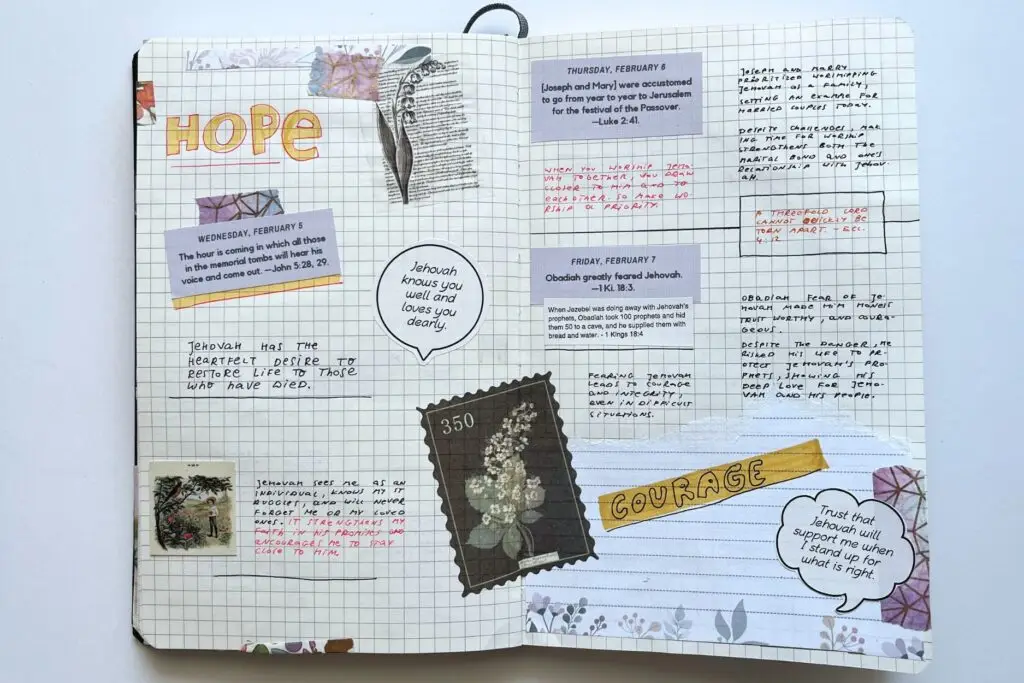
Spiritual journaling can sometimes look complicated when we see beautifully decorated notebooks online, but useful notes do not require perfect handwriting, expensive supplies, elaborate layouts, or carefully colour-coded pages.
Your page might contain three bullet points, a scripture reference, an arrow, and one sentence that would make little sense to anyone else. That is fine.
The purpose is not to create a beautiful notebook. The purpose is to help you think, remember, and meditate.
Start with one thought
If a blank notebook feels intimidating, try a very simple approach. After your Daily Text, Bible reading, Watchtower study, meeting, or personal study, write:
Today I want to remember…
Then finish the sentence.
It might be:
Jehovah notices endurance that others may never see.
Preparation can help me enjoy the ministry more.
Psalm 94:22. Jehovah is my Rock.
You do not have to fill a page every time you study. One meaningful thought is enough. Our goal is not simply to get through spiritual material or create pages of notes. We want to give ourselves time to think about what we are learning and allow it to affect us. For some of us, putting pen to paper creates that space.
The next time you sit down for personal study, place a notebook beside you and resist the urge to capture everything. Instead, notice the thoughts that make you stop, the scriptures you want to remember, and the lessons you want to carry with you.
Ongoing Study Inspiration
Want fresh ideas for your personal study, month after month? Join Study Corner!
Alongside my themed Study Bundles, I keep creating new resources for our ongoing spiritual routine.
Inside Study Corner, you’ll find Daily Text printables, Watchtower resources, a friendly community where we share notebook pages, swap ideas, and see how others approach their study. I love discovering how differently we can explore the same Bible subject!

Greetings! I am Alla Lily, and I have been on a quest to make my personal study more enjoyable and effective. I hope my study tools can help you transform your spiritual study routine and boost retention and comprehension of the material.